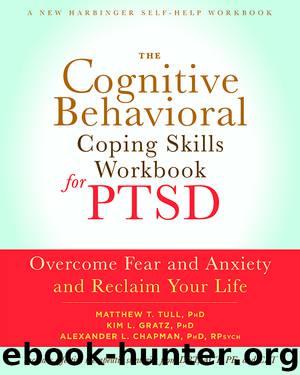
The Cognitive Behavioral Coping Skills Workbook for PTSD by Matthew T. Tull & Kim L Gratz & Alexander L Chapman
Author:Matthew T. Tull & Kim L Gratz & Alexander L Chapman
Language: eng
Format: epub
Tags: PSY045070 Psychology / Movements / Cognitive Behavioral Therapy (cbt), PSY022040 Psychology / Psychopathology / Post-traumatic Stress Disorder (ptsd), SEL043000 Self-help / Post-traumatic Stress Disorder (ptsd)
Publisher: New Harbinger Publications
Identifying the information provided by your emotions and using that information to guide your behavior can help you respond more effectively. This will also allow your emotions to pass more quickly. Think of your emotions as someone knocking at your door. If you don’t answer, that person is going to keep knocking at your door louder and louder until you respond. The same thing happens with emotions. If you don’t listen to your emotions, they tend to grow in intensity until you have no choice but to attend to them. On the other hand, if you listen to your emotions, they are able to pass.
Use exercise 6.2 to identify the information provided by your emotions. Each time you identify or label an emotion, consider what it’s telling you and how you can use that information to guide your behavior. First, briefly describe the situation that brought up the emotion. Next, list all of the emotions you experienced. Then, for each emotion you listed, use the third column to write down the information you think that emotion was providing you about the situation. Why did you experience this emotion? What was it telling you about the situation? Was it signaling danger or a threat of some kind (fear)? Were you experiencing a loss or a potential loss (sadness)? Were you doing something important to you (excitement) but concerned that it may not go well (anxiety)?
Next, in the fourth column, write down how you responded to that information. What did you do? Did you listen to the information provided by your emotion and respond accordingly? Or did you make another choice? Remember, just because an emotion is telling us to act in a certain way doesn’t mean we have to obey. In fact, in some situations, it may be in our best interest to not act directly on the information being provided by an emotion. For example, if you get anxious during a meeting, it probably wouldn’t be effective to run out of the room. The anxiety signals that the meeting is important to you, and that information can help you take it seriously and prepare in advance. However, responding to the signal of a threat by taking it literally and running away wouldn’t be as helpful. Generally, it’s most helpful to consider the information provided by your emotions and then assess how best to act on that information.
Finally, use the fifth column to identify if there were other ways you could have acted on the information provided by your emotions. Pay particular attention to responses that may have been more effective, or that would have used the information provided by your emotions in a more helpful way. We recommend that you keep several copies of this exercise with you so that you can fill them out throughout your day (they are available for download at http://www.newharbinger.com/32240). Filling them out as soon as you can after you have noticed and labeled an emotion will provide the best information, because it will be fresh in your mind.
Download
This site does not store any files on its server. We only index and link to content provided by other sites. Please contact the content providers to delete copyright contents if any and email us, we'll remove relevant links or contents immediately.
Rewire Your Anxious Brain by Catherine M. Pittman(18628)
Talking to Strangers by Malcolm Gladwell(13338)
The Art of Thinking Clearly by Rolf Dobelli(10400)
Mindhunter: Inside the FBI's Elite Serial Crime Unit by John E. Douglas & Mark Olshaker(9305)
Becoming Supernatural by Dr. Joe Dispenza(8191)
Change Your Questions, Change Your Life by Marilee Adams(7725)
Nudge - Improving Decisions about Health, Wealth, and Happiness by Thaler Sunstein(7684)
The Road Less Traveled by M. Scott Peck(7579)
The Lost Art of Listening by Michael P. Nichols(7485)
Mastermind: How to Think Like Sherlock Holmes by Maria Konnikova(7310)
Enlightenment Now: The Case for Reason, Science, Humanism, and Progress by Steven Pinker(7300)
Win Bigly by Scott Adams(7178)
The Way of Zen by Alan W. Watts(6587)
Daring Greatly by Brene Brown(6494)
Big Magic: Creative Living Beyond Fear by Elizabeth Gilbert(5733)
Grit by Angela Duckworth(5588)
Ego Is the Enemy by Ryan Holiday(5400)
Men In Love by Nancy Friday(5223)
The Laws of Human Nature by Robert Greene(5146)
